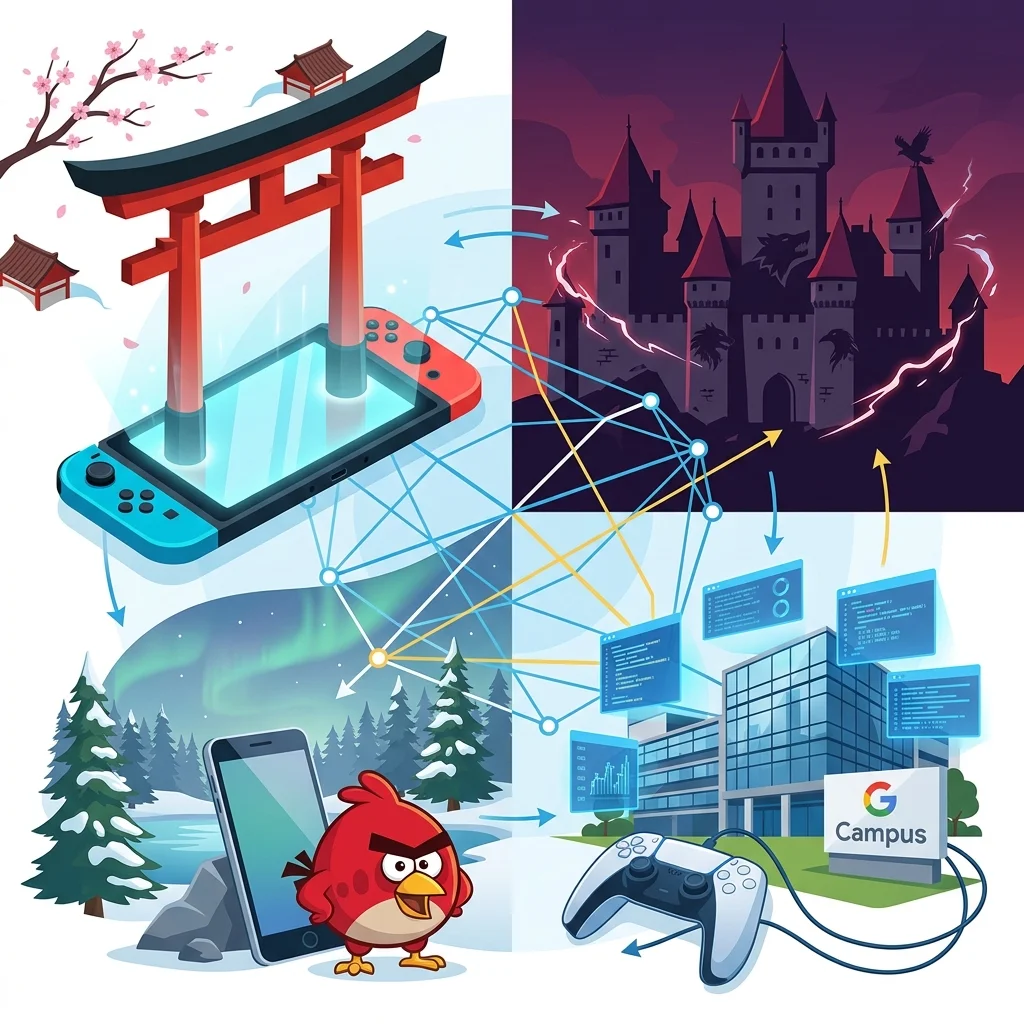
The DNA of Video Game Hubs: How Finland, Poland, Japan, and the US Built Global Gaming Empires (2024 WIPO Study)
How Four Distinct DNA Types Built Global Video Game Empires: A WIPO Analysis of Finland, Poland, Japan, and the US
The global video game industry, now larger than film and music combined, generates over $200 billion annually. Yet this vast economic output remains highly concentrated in a handful of regions. What explains the success of these concentrated hubs? A 2024 WIPO Economic Research Working Paper (No. 84) by Hakan Ozalp offers a compelling answer: there is no single formula. Instead, distinct historical paths, local capabilities, and adaptive strategies shape how these clusters emerge and thrive.
Drawing on qualitative methodology, the study compares four key hubs—Finland, Poland, Japan, and the United States—revealing that traditional entertainment powers and newer, resourceful entrants followed radically different trajectories. While Japan and the US leveraged existing entertainment and hardware ecosystems, Finland and Poland grew from hobbyist coding communities and aggressive localization. Understanding these DNA differences offers a blueprint for emerging clusters worldwide.
[IMAGE: World map with four highlighted countries, each with a small icon representing its game industry—Mario for Japan, Angry Birds for Finland, The Witcher for Poland, Xbox for US]
The Four Hubs: A Quick Tour of Distinct Origins
Each hub developed uniquely, shaped by local economic structure, cultural assets, and historical accidents.
Japan: Entertainment Crossover and Hardware Dominance
Japan’s game industry is inseparable from its pre-existing entertainment and consumer electronics sectors. Nintendo, originally a playing card company, pivoted to toys and then to video games. Sony entered the market from its hardware engineering roots. Sega emerged from arcade machines. Strong ties between anime, manga, and game intellectual property (IP) created a cross-pollination ecosystem rare elsewhere. Japanese developers grew up inside large, established corporations that provided capital, distribution, and brand recognition.
United States: Silicon Valley and Entertainment Conglomerates
The US hub combines two distinct streams. The first came from Silicon Valley hardware pioneers—Atari, Apple, and later Microsoft—who treated games as a software and computing challenge. The second came from Hollywood-style entertainment conglomerates (Disney, Warner Bros., Activision Blizzard) that applied blockbuster production logic to games. The US market emphasizes high-budget franchises, console ecosystems, and a strong PC gaming culture supported by venture capital.
Finland: From Nokia Crash to Mobile Gaming Success
Finland’s story is one of crisis-triggered innovation. When Nokia’s mobile phone business collapsed, thousands of skilled engineers flooded the labor market. Many had participated in Finland’s vibrant hobbyist demoscene—a subculture of coders creating real-time visual and audio demonstrations. These engineers formed the talent pool for studios like Rovio (Angry Birds) and Supercell (Clash of Clans). The early success of Apple’s App Store provided a distribution channel that bypassed traditional console gatekeepers. Finnish game development became synonymous with mobile gaming, lean teams, and data-driven design.
Poland: Garage Coding, Localization, and Government Support
Poland’s game industry emerged from a different crucible. During the 1990s, a thriving piracy culture meant Western games were widely available in Polish translation, often done by amateur enthusiasts. These translators—many operating from literal garages—developed deep technical knowledge of game engines and programming. Companies like CD Projekt and Techland began by localizing and distributing Western titles. They later built original IPs, most famously The Witcher series, which drew on Poland’s rich literary tradition. In the 2010s, the Polish government introduced targeted tax incentives for R&D in the creative sector, formalizing support for an industry already growing organically.
[IMAGE: Split collage showing historical photos—a Japanese Famicom, an early Apple II, Finnish demo party scene, Polish piracy-era game CD stands]
Traditional vs. Emerging Pathways: What Sets Them Apart?
Ozalp’s research identifies a fundamental divide between traditional and emerging hubs.
Traditional hubs—Japan and the US—enjoyed decades of accumulated capital and talent from adjacent industries like consumer electronics, film, and animation. Game development was a natural extension of existing entertainment industries. Distribution channels, brand equity, and consumer familiarity were already in place. These hubs could focus on large-scale, high-risk projects because the supporting ecosystem absorbed potential failures.
Newer hubs—Finland and Poland—lacked such infrastructure. They compensated through three key strategies:
Hobbyist Foundations: In both countries, game development began not in corporate R&D labs but in bedrooms and university computer labs. The Finnish demoscene and Polish localization communities created a pool of self-taught programmers who understood game mechanics intimately.
Mobile and Indie Distribution: The App Store and Steam disrupted traditional console-centric distribution models. For the first time, small teams in non-traditional hubs could reach global audiences without needing a physical retailer or a publisher in Los Angeles or Tokyo.
Aggressive Localization: Polish developers turned a liability—piracy—into a strength. By offering high-quality Polish-language versions of Western games, they captured a domestic market and developed technical capabilities that later supported original IP creation.
Key Drivers of Success: Cross-Industry Skill Transfer and Intellectual Property
Ozalp’s analysis highlights several common drivers across all four hubs, though applied differently.
Cross-Industry Skill Transfer
In Japan, the transfer came from anime and manga artists to game character designers. In the US, Hollywood screenwriters and producers moved into narrative-driven games. In Finland, the transfer was from mobile telecommunications engineering into game programming. In Poland, it was from literary adaptation and localization into original IP development. The ability to import skills from thriving adjacent sectors proved crucial.
Intellectual Property Management
All four hubs excel at IP creation and management, but through different mechanisms. Japanese companies tightly control characters: Mario, Pikachu, and Link are treated as long-term brand assets, licensed across media for decades. US studios focus on franchise expansion through sequels, spin-offs, and transmedia storytelling (e.g., the Marvel Cinematic Universe). Finnish companies like Rovio and Supercell maximize IP through live operations—continuously updating games with new content rather than releasing sequels. Polish IP strategy, represented by CD Projekt, focuses on deep world-building drawn from local literary heritage, creating assets that travel globally precisely because of their cultural specificity.
[IMAGE: Infographic showing four IP management models—Japan’s character licensing, US franchise expansion, Finland’s live operations, Poland’s literary adaptation]
Government Support: From Passive to Active
The role of government varies dramatically across the four hubs.
Japan’s government played a historically passive role. The industry grew organically from private sector giants without significant direct subsidies or policy intervention. In recent years, however, the Japanese government has begun promoting "Cool Japan" initiatives to export game and anime content, recognizing their soft power value.
The US government provides minimal direct support to the video game industry. Instead, the industry benefits from a broader ecosystem of venture capital, university computer science programs, and a massive domestic consumer market. Intellectual property law, particularly copyright and patent protection, has been the primary form of indirect government support.
Finland transformed government support from a crisis response into a long-term strategy. After Nokia’s collapse, the government funded retraining programs for displaced engineers. Tekes (now Business Finland) provided R&D grants to game startups. The education system integrated game development into computer science curricula. Municipalities offered subsidized office space for young studios. These interventions were targeted, time-limited, and designed to build self-sustaining industry momentum.
Poland represents the most deliberate recent example of government support. In 2016, the Polish government introduced a 19% tax deduction for R&D activities in the creative industries, including game development. This formal support complemented existing strengths: a deep pool of programmers from technical universities, a strong tradition of literary and fantasy culture, and a generation of developers who had grown up modding and localizing Western games. Government support did not create the industry—it amplified an already vibrant ecosystem.
[IMAGE: Bar chart comparing government R&D tax incentives and direct funding for game industries in the four countries]
Education: Nurturing the Next Generation
Education systems in the four hubs have adapted differently to industry needs.
Japan’s education system produces strong generalists in engineering and arts, with specialized game design programs emerging only recently. To practice, many young Japanese developers learn through part-time work at arcades or through doujin (self-published) game communities.
The US benefits from world-class computer science programs at Stanford, MIT, Carnegie Mellon, and USC. These universities maintain close ties with industry, and many game studios recruit directly from their graduates. Specialized game design schools, such as the USC Interactive Media & Games Division, provide dedicated pipelines.
Finland’s education system is arguably the most integrated with industry needs. Aalto University and the University of Tampere offer game design and development programs that include mandatory internship components. The government-funded Finnish Game Industry Association (Neogames) coordinates between universities and studios. This close linkage ensures graduates have practical skills and industry connections before entering the job market.
Poland’s technical universities—Warsaw University of Technology, AGH University of Kraków, and Wrocław University of Technology—produce large numbers of skilled programmers. However, formal game design programs are less developed than in Finland. The talent pipeline relies more on self-directed learning, modding communities, and the localization ecosystem. Polish developers often enter the industry through smaller studios before moving to larger ones.
[IMAGE: Diagram showing education-to-industry pipelines in each hub, with arrows indicating flow from universities to studios]
Conclusion: No Single Formula—Only Adaptable Strategies
The WIPO study’s central insight is that successful video game hubs cannot be replicated through a simple checklist of best practices. Each hub’s success emerged from a unique historical context, local capabilities, and adaptive responses to opportunity.
Japan and the US demonstrate the path of incumbents: leverage existing entertainment and hardware infrastructure, manage IP aggressively, and rely on large domestic markets. Finland and Poland demonstrate the path of challengers: start with hobbyist communities, exploit new distribution channels, specialize in underserved niches, and use targeted government support to amplify organic growth.
For emerging clusters in developing countries or smaller economies, the Finnish and Polish models are particularly instructive. They show that a lack of pre-existing entertainment infrastructure is not a barrier—it can even be an advantage. Hobbyist coding communities, mobile-first distribution, and localization capabilities can serve as foundations. Government support is most effective when it amplifies existing strengths rather than attempting to build an industry from scratch.
The key takeaway: there is no single formula for success in the video game industry. Success comes from understanding one's own capabilities, recognizing windows of opportunity, and adapting strategies to local context. The DNA of each hub is unique, but the principles of skill transfer, IP management, and targeted support apply everywhere.