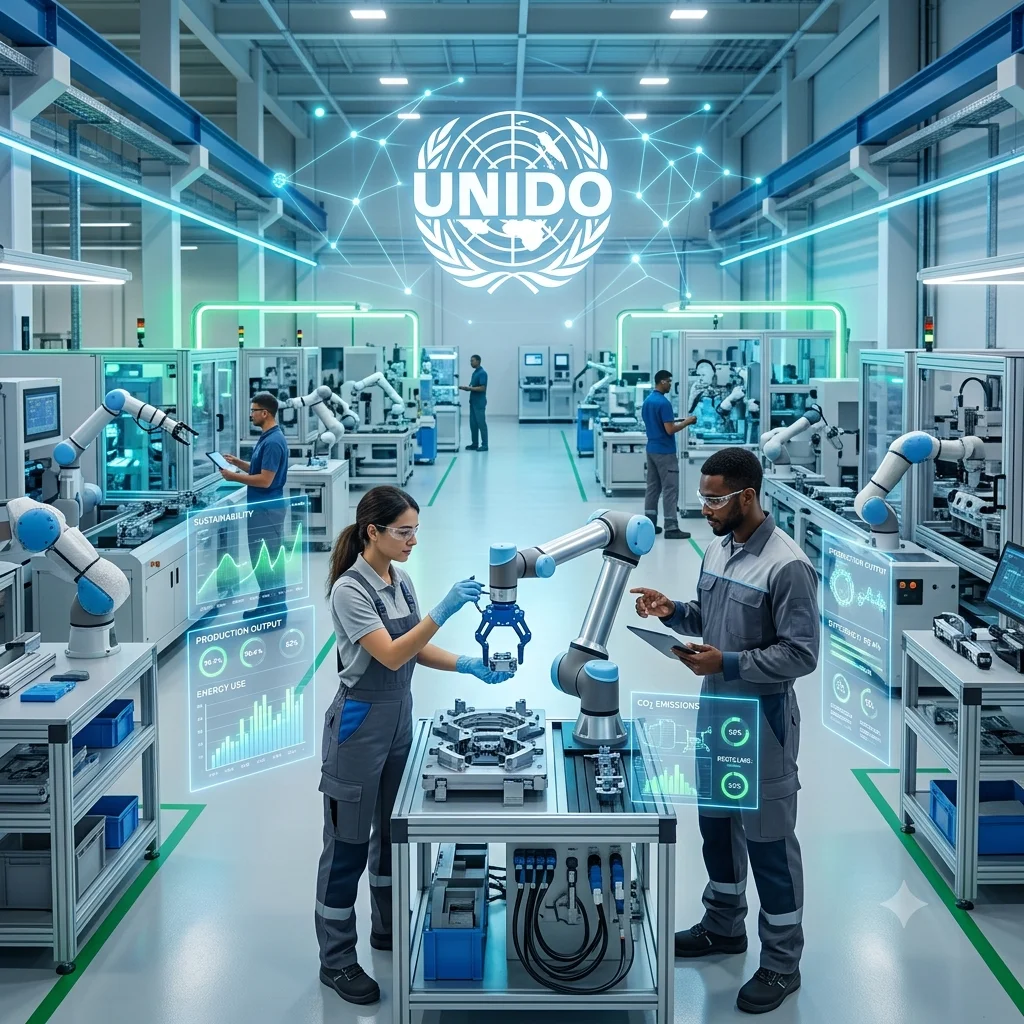
Redefining Global Manufacturing: Key Insights from UNIDO's Latest Report on Advanced Manufacturing Trends
Redefining Global Manufacturing: Key Insights from UNIDO's Latest Report on Advanced Manufacturing Trends
Introduction: The New Industrial Landscape According to UNIDO
Manufacturing remains the backbone of the global economy, contributing roughly 16% of world GDP and employing over 500 million people. Yet the sector is undergoing its most profound transformation since the assembly line. The United Nations Industrial Development Organization (UNIDO) has released a comprehensive report analyzing emerging trends in advanced manufacturing across more than 50 countries, drawing on factory-level data, trade flows, and policy surveys collected between 2022 and 2024.
The report’s core finding is unambiguous: advanced manufacturing is no longer about minimizing labor costs. It has become a capability-driven ecosystem where data agility, sustainability compliance, and supply chain resilience determine competitiveness. This article dissects the report’s key findings—from smart factory adoption and additive manufacturing to reshoring and circular economy practices—and examines the hidden economic logic reshaping gear and tech sectors, global business strategies, and industrial policy frameworks.
[IMAGE: World map with heat overlay showing manufacturing innovation clusters]
Smart Factories and the Digital Thread
The UNIDO report documents that Industry 4.0 technologies—IoT sensors, artificial intelligence, digital twins, and cloud-based manufacturing execution systems—are moving from early-adopter novelty to baseline expectation. Among factories surveyed in Germany, South Korea, and Singapore, over 60% have integrated at least two of these technologies into core production lines. The results are striking: early adopters report productivity gains of 20–30%, driven by predictive maintenance that reduces unplanned downtime by up to 45% and real-time quality control that cuts defect rates by half.
For the gear and tech sectors, the implications are immediate. Digital twins enable engineers to simulate gear wear under thousands of load scenarios before a single part is machined, compressing development cycles from months to weeks. Mass customization—once a marketing buzzword—becomes economically viable when changeover times shrink from hours to minutes through AI-driven scheduling. The report notes that manufacturers of precision components are now offering customers “digital twins as a service,” allowing predictive maintenance of installed gear systems and creating recurring revenue streams.
[IMAGE: Cutaway view of a smart factory floor with sensor nodes and data streams]
Additive Manufacturing: From Prototyping to Production
One of the report’s most striking findings is the maturation of additive manufacturing. UNIDO data shows a 40% year-on-year increase in industrial 3D printing use for end-use parts—not just prototypes. Industries such as aerospace, medical devices, and automotive are now printing turbine blades, orthopedic implants, and transmission components directly from metal and ceramic powders.
The shift toward localized, on-demand production is redefining supply chain economics. A single metal 3D printer can replace dozens of traditional casting and machining steps, eliminating the need for tooling and reducing logistics costs by up to 70% when parts are produced near the point of use. The report highlights a case in Southeast Asia where a medical device manufacturer reduced its spare parts inventory by 85% by printing on-demand rather than warehousing components. This elasticity is particularly valuable for sectors like aerospace, where holding spare parts for legacy aircraft is extremely capital-intensive.
[IMAGE: Metal 3D printer building a complex turbine blade with glowing layers]
Sustainability as a Competitive Mandate
The UNIDO report explicitly links advanced manufacturing with net-zero targets, arguing that green technology adoption is no longer optional. Energy-efficient processes—such as regenerative braking in machining centers, waste-heat recovery systems, and AI-optimized furnace schedules—are reducing factory energy consumption by 15–25% even as output increases.
Material circularity is another pillar. The report documents that manufacturers using closed-loop systems—where scrap metal is immediately remelted, plastics are recycled into filament for on-site 3D printing, and cutting fluids are filtered and reused—report raw material cost savings of 12–18%. Policy push from governments is accelerating this trend: the European Union’s Carbon Border Adjustment Mechanism (CBAM) and the U.S. Inflation Reduction Act (IRA) both incentivize low-carbon production with tax credits and border adjustments, effectively penalizing manufacturers that fail to decarbonize.
The market dynamics are equally compelling. The report’s consumer surveys show that 68% of B2B buyers in Europe and North America now prioritize suppliers with verified low-carbon footprints, even if products carry a 5–10% price premium. Sustainability has become a competitive differentiator, not a compliance cost.
[IMAGE: Infographic showing closed-loop material flows between manufacturing, use, and recycling]
Reshoring and Regional Manufacturing Ecosystems
Perhaps the most geopolitically charged finding in the UNIDO report is the reversal of decades of offshoring. The data reveals a clear trend: supply chain disruptions during the pandemic, combined with rising geopolitical tensions, have triggered a wave of reshoring and nearshoring, particularly in semiconductors, batteries, and medical devices.
The report highlights that automation is a key enabler. As robots and AI reduce labor’s share of total production costs, the wage gap between developed and developing countries becomes less decisive. A factory in Ohio or Baden-Württemberg can now compete on cost with one in Shenzhen if it runs at high automation levels—and it offers advantages in lead time, intellectual property protection, and regulatory compliance.
The long-term impact, according to UNIDO, will be the formation of three dominant manufacturing hubs: North America (centered on the U.S.-Mexico corridor), Europe (anchored by Germany and Eastern European assembly nodes), and Southeast Asia (led by Vietnam, Thailand, and Malaysia). These hubs will not be self-sufficient but will create regional supply chains that are shorter, more transparent, and more resilient than the globalized networks of the past.
[IMAGE: Map with arrows showing trade flows shrinking and regional clusters growing]
Policy and Innovation Patterns: The Role of Government in Shaping the Future
The UNIDO report also scrutinizes the evolving role of government policy. It identifies three categories of policy intervention that are proving most effective in accelerating advanced manufacturing adoption.
First, direct investment in R&D infrastructure: Countries like South Korea and Singapore are building national additive manufacturing centers where small and medium-sized enterprises can access industrial-scale printers and certification labs without capital outlay. The report notes that every dollar of public R&D spending in these centers generates $3.50 in private-sector follow-on investment.
Second, skills and workforce retraining: The shift to data-driven manufacturing demands a workforce literate in data science, mechatronics, and systems integration. Germany’s “Industry 4.0” vocational training programs, which combine classroom learning with on-site digital factory training, are cited as a model. UNIDO data shows that factories in countries with robust retraining programs experienced 40% faster adoption of AI-based quality control systems.
Third, regulatory sandboxes for new technologies: Several nations are creating temporary exemptions from existing safety and liability regulations to allow manufacturers to test autonomous logistics robots, AI-driven decision-making, and blockchain-based supply chain tracking in live production environments. These sandboxes have reduced time-to-market for new advanced manufacturing solutions by an average of 18 months.
The report cautions, however, that policy fragmentation remains a risk. Without international coordination on standards for data interoperability, carbon accounting, and digital product passports, the promised efficiencies of advanced manufacturing could be offset by compliance costs.
[IMAGE: Policy timeline showing key interventions across countries]
Conclusion: The New Logic of Manufacturing Competitiveness
UNIDO’s report makes one thing clear: the era of cheap-labor-driven manufacturing is ending. Advanced manufacturing is being redefined around data-driven agility, sustainability compliance, and regional resilience. Smart factories, additive production, circular material flows, and reshored supply chains are not separate trends—they are interconnected components of a new industrial paradigm.
For companies in the gear and tech sectors, the message is urgent. Those that invest in digital thread integration, localized additive capacity, and green process innovation will not only survive but gain structural advantages. Those that wait risk being locked out of supply chains that increasingly demand real-time traceability, low carbon footprints, and the ability to pivot production at the speed of data.
The policy implications are equally profound. Governments that invest in R&D infrastructure, workforce transformation, and regulatory innovation will attract the factories of the future. Those that cling to old models of industrial policy—subsidies for labor-intensive assembly, protection of incumbents, resistance to automation—will see their manufacturing bases erode further.
UNIDO’s data offers a roadmap. The question is not whether manufacturing will change, but who will lead the change.
[IMAGE: Futuristic assembly line with collaborative robots and holographic sustainability dashboards, blue-green lighting]