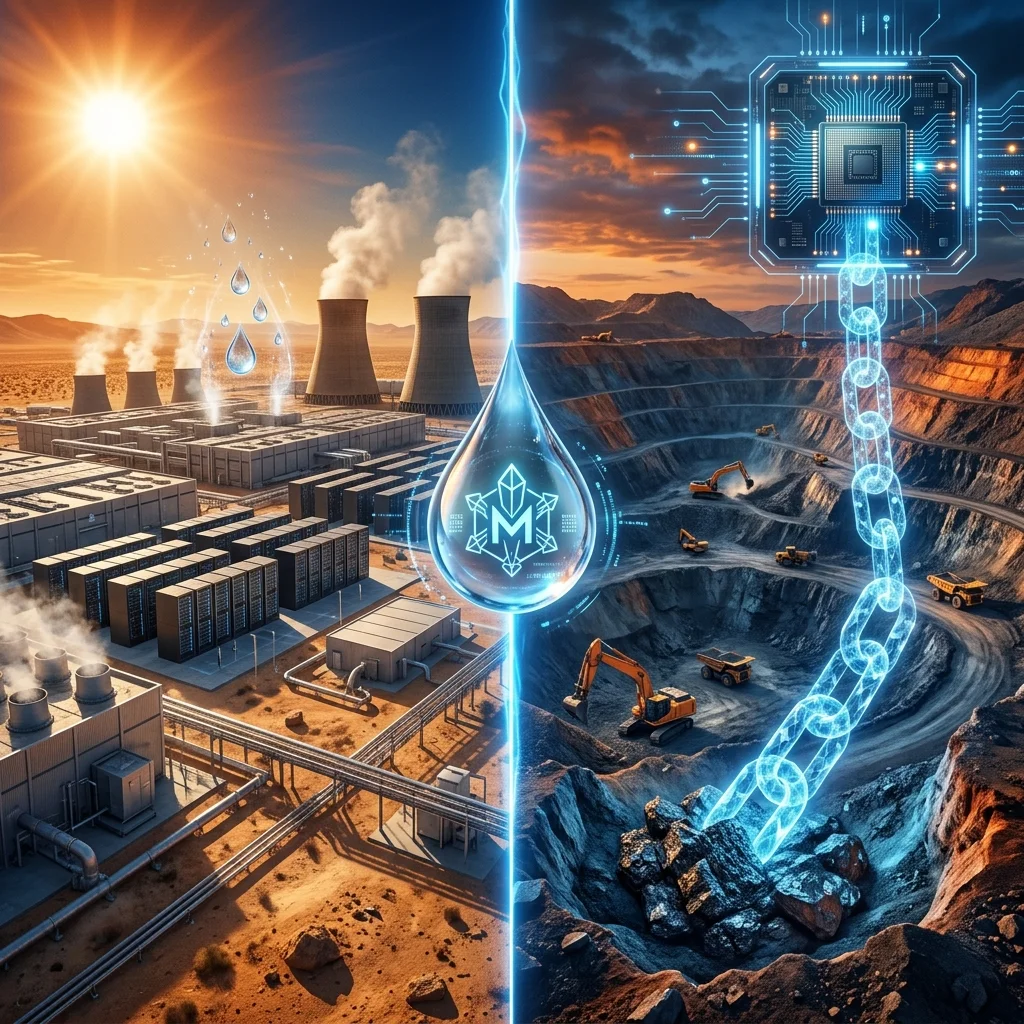
Data Centers, Drought, and Critical Minerals: The Hidden Convergence Reshaping Innovation
```markdown
Data Centers, Drought, and Critical Minerals: The Hidden Convergence Reshaping Innovation
May 20, 2026 — The University of Utah’s Technology Licensing Office released its bi‑weekly market research report today, revealing two seemingly separate crises that are quietly colliding: the relentless expansion of AI data infrastructure in arid landscapes, and the fragile geopolitics of critical mineral supply chains. Beneath the surface, however, the report uncovers a unified economic logic that could redefine innovation priorities for faculty and industry alike.
“Protection of water resources in arid regions is becoming a key political and economic priority,” the report states. At the same time, export controls and concentration risks around rare earths and lithium are forcing companies to demand end‑to‑end traceability from mine to microchip. What links these pressures? The same infrastructure that powers machine learning also consumes staggering volumes of water, while the membranes, chips, and cooling fluids that make that infrastructure possible depend on minerals whose origins are opaque. This convergence creates a market pull for technologies that can independently validate both water resilience and mineral provenance — a gap that university researchers are uniquely positioned to fill.
[IMAGE: Aerial view of a data center complex next to a receding lake shoreline, with cooling towers emitting steam under a harsh sun.]
---
The Water‑Tech Imperative: From Cloud Seeding to Low‑Cooling Systems
Utah’s Great Salt Lake has shrunk by nearly two‑thirds since the 1980s, a trend amplified by population growth and now by the voracious water appetite of AI data centers. A single large‑scale facility can consume 1–3 million gallons of water per day for evaporative cooling — equivalent to the daily use of a small city. As drought‑prone states compete for water rights, the demand for alternative water sources and low‑water cooling technologies has surged.
Technologies under serious consideration include:
- Cloud seeding — to augment precipitation in targeted watersheds;
- Atmospheric water harvesting — extracting moisture from air, even in dry climates;
- Advanced water reuse — treating and recirculating wastewater within facility loops;
- Low‑water or closed‑loop cooling — such as immersion cooling or dry cooling towers.
Yet the market does not simply need more gadgets. It needs independent verification systems that can answer critical questions: Did cloud seeding actually increase yield, or was it natural variability? Does a new cooling technology reduce consumption as claimed, or does it shift the burden elsewhere? What are the contaminant risks, energy intensity, and watershed‑level impact of a given water‑tech deployment?
This is where faculty innovation becomes essential. Engineers, environmental scientists, data modelers, and policy experts can collaborate to design validation frameworks — metrics, sensors, audit protocols — that give regulators and investors confidence. The June 11, 2026 webinar “AI‑Enabled Reverse Osmosis Efficiency: From Membrane Optimization to Real‑Time Performance Tracking,” hosted by the DuPont Water Academy, illustrates the direction: machine learning is being used not only to improve water treatment but also to monitor and certify its performance in real time.
“Water resilience technology validation is a gap the private sector is only beginning to recognize,” says Dr. Elena Marchetti, director of the University of Utah’s Water‑Energy Nexus Lab. “Universities can act as neutral third parties, building the testing regimes and data standards that will underpin future procurement decisions.”
[IMAGE: Graphic showing water flow from a data center cooling loop connected to a cloud‑seeding drone and an atmospheric water harvesting unit, with measurement nodes at each stage.]
---
Critical Minerals: The Hidden Link to Water and Data
The same AI expansion that drives water stress also depends on a supply chain that is geographically concentrated and geopolitically fragile. Rare earth elements (neodymium, dysprosium) are essential for the powerful magnets in data center cooling pumps and wind turbines. Lithium and cobalt fuel the batteries that back up server farms. And the high‑performance membranes used in water‑treatment reverse osmosis systems rely on specialty chemicals derived from mineral processing.
China controls more than 80% of rare earth refining and a growing share of lithium processing. Recent export controls on gallium, germanium, and antimony — all critical for semiconductor manufacturing — have sent shockwaves through the tech industry. The result is an urgent corporate demand for supply chain traceability: a verifiable chain of custody from mine to end user that proves origin, ethical sourcing, and compliance with regulations.
Yet current traceability systems are fragmented, costly, and often lack interoperability. Different mining companies use different blockchain platforms; customs authorities require different data fields; buyers demand confidentiality for their sourcing strategies. A universal, secure, and low‑cost verification framework does not exist.
Once again, faculty can step in. Researchers in computer science, materials science, business, and law can develop:
- Interoperable data standards that allow different platforms to communicate;
- Secure verification protocols using zero‑knowledge proofs to protect confidential business information;
- Scalable traceability models that work for small artisanal mines as well as large industrial operations.
The University of Utah Library’s market research tools — including MarketsandMarkets, BCC Research, Factiva, and PitchBook — provide the raw data on market size, startup funding, and regulatory trends that can guide faculty toward the most commercially relevant research questions. A Lux Research webinar on critical minerals traceability, also scheduled for June 11, 2026, will delve into the latest industry approaches.
“The traceability challenge is not just technical; it’s about trust,” notes Professor James Okonkwo, who leads the university’s blockchain research initiative. “We need systems that are transparent enough for auditors but confidential enough for companies to adopt. That balance requires academic rigor free from commercial bias.”
[IMAGE: Blockchain‑style diagram linking a lithium mine in Chile to a data center server rack, with water droplets embedded in each link of the chain, and a verification node showing “validated” status.]
---
The Convergence: Why Water Resilience and Mineral Traceability Are Two Sides of the Same Innovation Coin
At first glance, water‑tech validation and mineral provenance may appear unrelated. But the market research report argues they share a fundamental structure: both are verification‑intensive markets where the value of a technology depends on the credibility of the claims made about it. In water, the claim is about yield, consumption, and environmental impact. In minerals, the claim is about origin, ethics, and compliance.
Both markets suffer from the same barrier: lack of trusted, independent validation. Private vendors sell verification services, but conflicts of interest and varying methodologies undermine confidence. Regulators hesitate to mandate standards that may be obsolete in two years. Investors struggle to compare competing technologies.
The University of Utah report proposes a unified framework: faculty can design cross‑domain verification platforms that apply the same principles — real‑time sensing, blockchain audit trails, machine‑learning anomaly detection, and open‑source reference metrics — to both water resilience and mineral traceability. Such platforms would leverage existing university strengths in environmental monitoring (the U’s Bingham Research Center), distributed systems (the School of Computing), and policy (the S.J. Quinney College of Law).
The economic opportunity is substantial. The global water‑tech validation market is projected to reach $12 billion by 2030, while the mineral traceability market is estimated to grow to $8 billion in the same period. These figures do not include the larger “adjacent” markets of water treatment equipment and mineral supply chain software, where validated claims command premium pricing.
“The convergence of water stress and mineral insecurity is a wake‑up call,” says the report’s lead analyst, Maria Vasquez. “Innovation that solves one problem in isolation is no longer enough. The next generation of technologies must address both — and they need credible systems to prove they do.”
[IMAGE: Split graphic showing a water droplet on the left reflecting a lithium icon, and on the right a microchip reflecting a blockchain symbol, connected by a loop labeled “Validation Platform.”]
---
What Faculty Can Do Now
The report highlights several immediate actions for University of Utah researchers:
1. Attend the upcoming webinars (June 11, 2026): “AI‑Enabled Reverse Osmosis Efficiency” (DuPont Water Academy) and “Critical Minerals Supply Chain Traceability” (Lux Research). Both will offer insights into current market needs.
2. Access the library’s market research tools — MarketsandMarkets, BCC Research, Factiva, PitchBook — to identify commercial whitespace for validation technologies.
3. Form cross‑disciplinary teams combining engineering, environmental science, data analytics, and law to propose pilot validation projects.
4. Engage with the Technology Licensing Office to translate research into licensing opportunities or startup ventures.
The Technology Licensing Office will host a follow‑up workshop on June 25, 2026, to discuss how faculty can submit concept papers for a new “Convergence Innovation” seed fund. Details will be announced via the university’s research newsletter.
---
Conclusion: The New Frontier of Trust
The twin pressures of aridification and AI are not merely environmental and technological challenges — they are fundamentally challenges of trust. Can we trust that a cloud‑seeding operation added water without harming the watershed? Can we trust that a lithium battery was sourced without conflict minerals? The answers require systems that are transparent, verifiable, and independent.
The University of Utah’s Faculty Innovation & Commercialization report for May 2026 makes a compelling case that the same underlying architecture can serve both needs. Researchers who build that architecture will not only advance their fields — they will shape the standards that govern the next wave of sustainable infrastructure.
As the report concludes: “The convergence of water resilience and critical mineral traceability is not a coincidence. It is the hidden logic of a world where data, drought, and resources are inextricably linked. Those who recognize it first will define the innovation agenda for the decade ahead.”
[IMAGE: Futuristic split composition: left side shows a massive data center with cooling towers under a blazing sun, water droplets evaporating; right side shows a mineral mine with transparent blockchain‑like chains linking raw ore to a microchip. In the center, a single drop of water reflects a critical mineral icon.]
---
*For more information, contact the University of Utah Technology Licensing Office or visit the library’s market research portal. The full bi‑weekly report is available to faculty and staff upon request.*
```